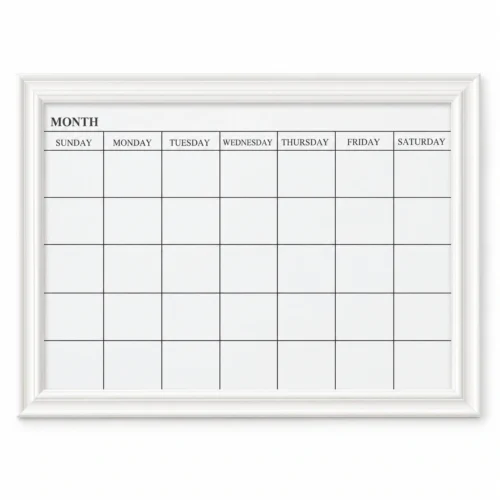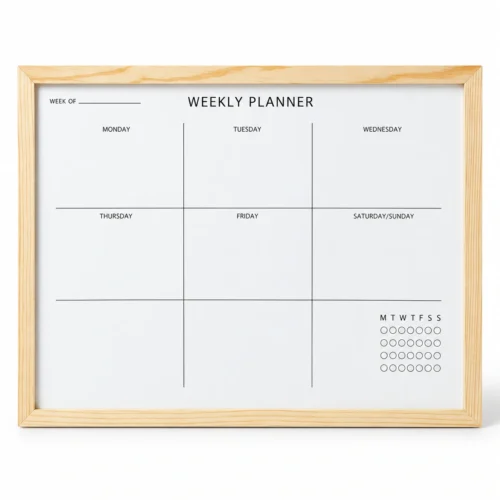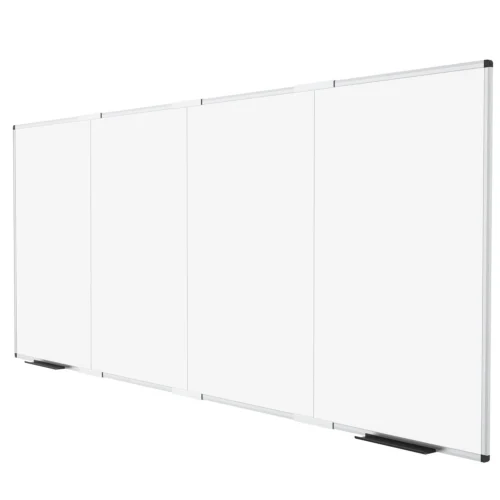
In a warehouse, distribution center or logistics hub, plans change all day. Trucks arrive early or late, orders spike, someone calls in sick, and a forklift goes down for maintenance. Warehouse management systems track the data, but the people on the floor need a simple, shared view of what matters right now. A large whiteboard at the shift briefing point provides exactly that, readable by everyone and updated in seconds with a marker or a magnet.
This guide covers the most useful warehouse boards, how to lay them out and what to consider when buying for industrial spaces.
The Shift Plan Board
The shift plan board is the heart of the daily briefing. It tells every team member where they are working, what the priorities are and who to go to with problems. A practical layout includes:
- Zones or functions down the left side: receiving, put-away, picking, packing, dispatch, returns.
- Name magnets for each worker, moved into the zone they cover today.
- Shift lead and contacts clearly written at the top.
- Priorities for the shift, such as a key customer cut-off or a stock count.
Name magnets are the key time saver. Instead of rewriting a roster each shift, the supervisor simply moves magnets. A magnetic surface is therefore essential; see our magnetic whiteboards for wall-mounted options in larger sizes, such as the aluminum frame magnetic whiteboard for walls.
Dock and Yard Schedule Boards
A board near the dock doors that lists each door, the expected carrier, arrival time, status and the person responsible helps prevent congestion and missed loads. Use simple status codes or colored magnets, for example:
- Expected
- On site, waiting for door
- Loading or unloading
- Complete, paperwork signed
Because dock areas can be drafty and dusty, a sturdy framed board mounted firmly to the wall or a steel column is better than a lightweight panel. Draw the grid with tape or have it pre-printed so it survives daily cleaning.
Daily KPI Boards
Visual performance boards help teams understand how they are doing and where to improve. Keep the number of metrics small, usually four to six, and choose ones the team can actually influence:
- Orders picked and shipped against plan
- Picking accuracy or errors found at packing
- Trucks loaded on time
- Safety: days since last incident or near misses reported
Update the board at the same time every day, ideally at the start-of-shift meeting, and use a simple green or red mark next to each figure so the status is clear from a distance. Our article on office whiteboards for team productivity has more ideas for visual tracking that translate well to the warehouse floor.
Safety Notices and Communication
Safety messages need to be impossible to miss. A dedicated safety board, separate from the production boards, keeps them from getting lost among daily figures. Use it for:
- The safety topic of the week
- Areas temporarily closed or under maintenance
- Equipment out of service and expected return
- Reminders about protective equipment and traffic routes
Official signage required by local regulations should still be permanent; the whiteboard is for timely reminders and changing conditions. A combination board with a cork section is handy here for pinning printed procedures and inspection checklists next to handwritten updates.
Boards for Inventory Counts and Improvement Projects
Periodic stock counts, peak-season preparation and continuous improvement projects all benefit from their own temporary board. During a cycle count, for example, a board can list every aisle or location range, the counter assigned to it, and whether it is counted, checked or showing a discrepancy. Supervisors can see progress at a glance and send help where counting is falling behind.
For improvement projects, a simple problem-solving layout works well: the problem, the root cause, the agreed actions, the owner and the due date. Keeping it on the floor rather than in an office means the people closest to the work can add ideas and see when actions are completed.
Give Every Board an Owner
Boards that belong to everyone tend to be updated by no one. Assign each board to a named supervisor or team lead, write their name in the corner, and make updating it part of the shift handover checklist. If a board has not been touched in a week, either give it a new purpose or take it down so the important ones keep their impact.
Mobile Boards for Flexible Areas
Not every area has a convenient wall. In open warehouses, a double-sided board on wheels can serve as a briefing point and be moved when racking or layouts change. One side can hold the shift plan and the other the KPIs. Look at our mobile whiteboards, including the double-sided rolling whiteboard.
Buying Tips for Industrial Spaces
- Go bigger than you think. Boards are read from several meters away during briefings.
- Choose a durable surface. Enamel, painted steel and glass handle heavy daily use better than melamine.
- Use thick markers in black, blue, red and green for maximum contrast.
- Standardize across sites so staff moving between warehouses find the same layout.
Plan Your Warehouse Boards
Large and mobile boards are quoted with freight to your address, so it is worth listing every board you need in one request. Tell us the sizes, quantities and any pre-printed grid or logo through our quote form, or contact us to talk through your layout. Production usually takes about 10 days before shipping.
Shop the boards in this guide