Picking a whiteboard size looks simple until the board arrives and the back row cannot read it, or it covers a door frame. The right size depends on three things: how far away people sit, how many people write at once, and how much wall you actually have. This guide walks through each one and gives practical size ranges for offices, classrooms, homes and shops.
Start with viewing distance
A useful rule of thumb from signage design is that letters about 1 inch (2.5 cm) tall can be read comfortably from roughly 10 feet (3 m) away. Most people write on a whiteboard at 1 to 2 inches high, so a board that suits a room is one where your normal handwriting can be read from the furthest seat.
- Up to 3 m (10 ft): desks, small offices, home study areas. Small and medium boards work well.
- 3–6 m (10–20 ft): meeting rooms and small classrooms. You need a larger board so you can write bigger without running out of space.
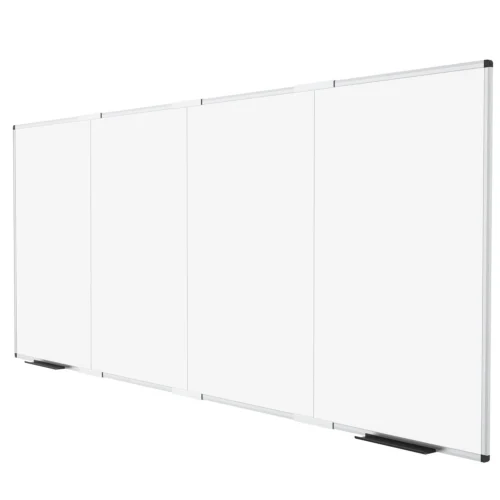
- Over 6 m (20 ft): large classrooms and training rooms. Use the largest board the wall allows, or two boards side by side.
Common sizes and where they fit
Sizes are usually given as width × height. Here is how the most common sizes are typically used:
- 20 × 30 cm (8″ × 12″) and 30 × 40 cm (12″ × 16″): personal boards for a desk, fridge, locker or reception counter. Good for to-do lists, messages and prices.
- 40 × 60 cm (16″ × 24″): a home office, a small team’s task list or a shop menu board.
- 60 × 90 cm (24″ × 36″): the most versatile size for small offices and huddle spaces. It fits most walls and holds a short meeting’s notes.
- 90 × 120 cm (36″ × 48″) and larger: meeting rooms, project rooms and classrooms where several people write at the same time.
- 120 × 180 cm (48″ × 72″) and up: large classrooms, training rooms and planning walls.
Measure the wall before you choose
Measure the free wall area and leave space around the board: at least 10–15 cm (4–6″) from door frames, light switches and corners. Mount the board so its centre sits at about eye level for the people who will write on it. For adults standing, the bottom edge is often about 90 cm (36″) from the floor; for younger students, mount it lower. If the wall is short or shared, a mobile whiteboard on wheels gives you a large surface without fixing anything to the wall, and you can move it between rooms.
Landscape or portrait?
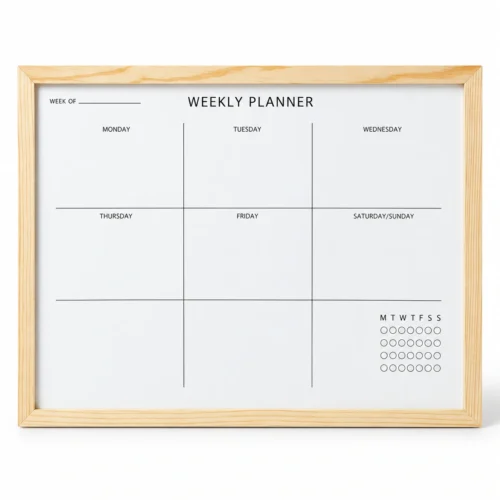
Landscape boards suit meetings, timelines and lessons because people naturally write from left to right. Portrait boards fit narrow walls, door sides and entrances, and work well for lists, menus and schedules. Calendars and planners usually come in landscape so each week or month has room for notes.
Think about what goes on the board
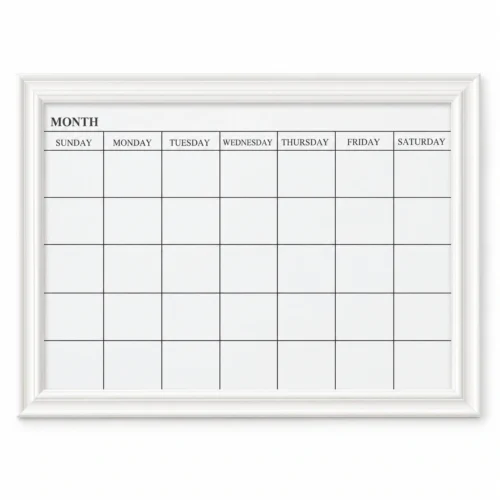
If you plan to pin papers as well as write, a combination whiteboard with a cork area saves wall space. If the board will hold a fixed layout, such as a monthly schedule, a printed whiteboard calendar is easier to keep tidy than drawing the grid by hand. For magnets, check that the surface is magnetic; our magnetic whiteboards have a painted steel surface that holds magnets.
Quick size checklist
- How far is the furthest seat? Choose a board where normal writing is readable from there.
- How many people will write at the same time? Allow about 60–90 cm (2–3 ft) of width per person.
- How much free wall is there after clearances?
- Do you need magnets, a pin area or a printed layout?
- Will the board stay in one room or move around?
Ordering for several rooms
When you equip a whole office or school, it often makes sense to standardise on two or three sizes so frames and accessories match. You can order listed sizes online at the per-piece prices shown, try selected boards from 1 piece, or send us your room list for a quote on custom sizes and printing.
Shop the boards in this guide