A reversible whiteboard looks like a regular mobile board until someone releases the catch and spins the board over to reveal a second face. That simple movement solves several everyday problems: preparing material in advance, hiding information from visitors, and doubling the writing space without taking more floor. This article explains how flip-over boards work, how they compare to other two-sided boards, and who gets the most value from them.
How a Reversible Whiteboard Works
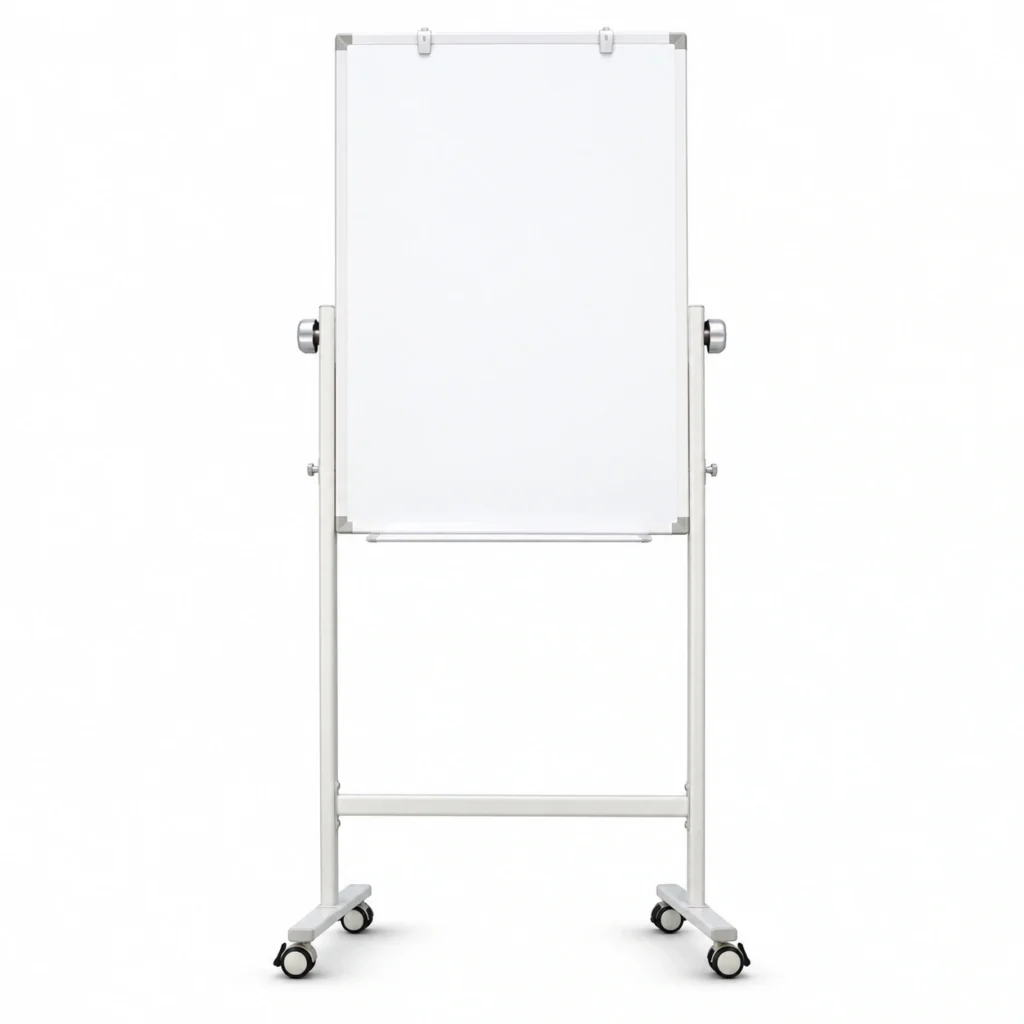
The board is mounted inside the stand on two pivot points, one on each side. A locking mechanism holds it in place while you write. When you release it, the board rotates around its horizontal axis so the back face becomes the front. Most designs let the board lock in the upright position on either face, and some also allow it to be held at an angle or flat.
- Pivot and lock: check that the lock is easy to operate with one hand and holds firmly while writing.
- Stand design: many reversible boards use a frame with one or two crossbars and casters. Single-crossbar designs, keep the lower area open.
- Casters: look for locking wheels so the board does not drift while you write or flip.
Reversible vs Double-Sided vs Tilting
These three terms often appear together, but they describe different designs.
- Double-sided (fixed): the board has two writing faces but stays fixed in the frame. To use the back, you walk around or turn the whole stand.
- Reversible (flip-over): the board rotates within the frame so either face can be brought to the front without moving the stand.
- Tilting: the board can be angled or laid flat, which helps with writing comfort and storage. Some tilting boards are also double-sided.
If your users always stand in front of the board and need to switch faces quickly, reversible is usually the most practical choice.
Who Needs a Reversible Whiteboard?
Teachers
Prepare a quiz, a diagram or the day’s answers on the back face before class, then flip it at the right moment. The front face stays free for live teaching. For more classroom setups, see whiteboard ideas for classrooms and learning spaces.
Trainers and workshop facilitators
Keep the agenda or key frameworks on one face for the whole session and use the other for exercises and group answers. Flip back to the agenda whenever you need to reset the room.
Offices with visitors
Sales pipelines, salary planning, client names and product roadmaps should not be on display when guests walk through. Flipping the board hides sensitive work in seconds without erasing it.
Production and operations teams
One face can hold the fixed shift plan or safety reminders while the other is used for daily notes and issues. Each shift sees both without anyone needing a second board.
Healthcare and care settings
Staff rotas, patient flow and room status can stay on the private side, with general information on the public side.
If none of these situations sounds familiar, a reversible board may be more than you need. When people only ever use one face, or the board stays against a wall, a fixed single-sided mobile board or a wall-mounted board is simpler and leaves budget for more units elsewhere.
Premium vs Economy Models
Reversible boards are often offered in different build levels. Premium models typically focus on a sturdier frame, smoother pivot action and better casters for frequent moves. Economy models suit rooms where the board is flipped less often and moved occasionally. Compare the premium reversible mobile whiteboard with the economy reversible mobile whiteboard to see how specifications differ for your use.
A simple rule: if the board will move between rooms every day or be flipped many times per session, choose the sturdier option. If it will mostly stay in one room, an economy model may be all you need.
Whichever level you choose, test the flip action with the people who will use it most. A mechanism that feels easy to a facilities manager may feel stiff to a teacher flipping the board ten times a day.
Tips for Using a Flip-Over Board Well
- Lock the casters before flipping so the stand does not roll as the board turns.
- Clear the pen tray first. Markers and erasers left on the tray will fall when the board rotates.
- Remove loose magnets and papers or use strong magnets that will hold as the board turns.
- Label the faces. A small tag such as “A” and “B” on the frame helps teams agree which side holds what.
- Check clearance. Make sure there is space above and around the board so it does not hit lights, shelves or people when it rotates.
What to Include in Your Quote Request
Reversible boards are large items, so they are quoted with freight to your address. To get an accurate quote quickly, include:
- The model or style you prefer and the board size.
- The quantity and the delivery address.
- Any access notes, such as stairs, lifts or a loading dock.
- Whether you need custom printing, such as a grid or logo; custom printed designs usually start from 100 pieces.
Production usually takes about 10 days, followed by sea freight of roughly 30–40 days economy or 20–25 days fast. For more ideas on moving boards between spaces, read portable boards for flexible meetings and training rooms.
Find the Right Reversible Board
Browse reversible, double-sided and tilting models in our mobile whiteboards category. When you are ready, request a quote and we will confirm the complete price, including delivery, before you pay.
Shop the boards in this guide